FREE SHIPPING ON ORDERS OVER $55
NOW AVAILABLE: THE FALL COLLECTION
QUALITY, HANDMADE PRODUCTS SINCE 2018

CONSUMER'S GUIDE
What's Actually in Your Candle? An Honest Guide to Non-Toxic Candle Ingredients
By Heather C., Founder
Last updated: September 2026
TL;DR - The Quick Version
Most candles don't tell you what's in them, and legally they don't have to — "fragrance" on a label can cover thousands of undisclosed ingredients. What's commonly inside a mass-market candle: paraffin wax (a byproduct of petroleum refining), synthetic dyes, and fragrance oils that may contain phthalates. The thing you can actually see is soot — the black film on the jar, the wall, the ceiling. Soot is unburned carbon, and it was in the air before it landed. It's caused by incomplete combustion: a wick sized wrong for the vessel, a fragrance load heavier than the wick can carry, and a candle that was never burn-tested. Ours are coconut soy, phthalate-free, dye-free, wooden-wicked, and thoroughly burn-tested in every scent and wick combination before they ship.
Start by looking at your ceiling
Before you read anything else, go look at the wall above wherever you burn candles most. Then look at the rim of the jar itself, and the inside of the glass near the top.
If you've been burning typical store-bought candles, you'll probably find a blackish film on the wall and a band of black around the jar. That's soot. It's unburned carbon, and it didn't appear on the wall by magic — it was floating in the room first, and some of it settled there. Some of it you breathed.
I'm starting here because it's the one part of this conversation you don't have to take anyone's word for. Most arguments about candle ingredients involve claims you can't verify standing in your own living room. This one you can check in about ten seconds.
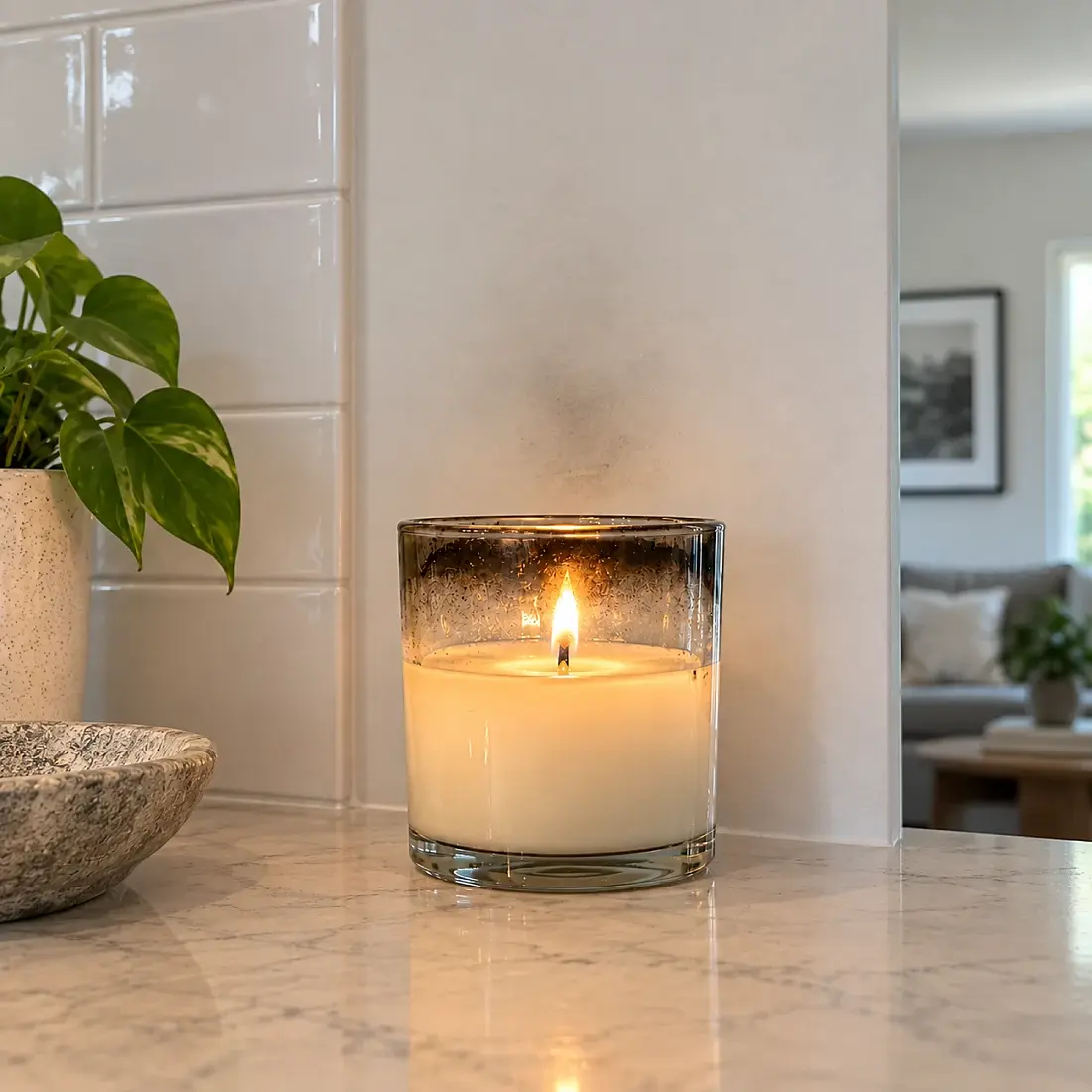
Soot buildup on a typical, mass-market candle
The real problem: you can't find out what's in most candles
When I started making candles, the thing that genuinely surprised me wasn't any single ingredient. It was how little anyone is required to tell you.
Candles aren't regulated the way food or cosmetics are. There's no mandatory ingredient panel. And the fragrance— which is usually the largest variable in any candle — is typically protected as a trade secret. A brand can print the single word fragrance on a label and that one word can legally stand in for thousands of possible compounds. You have no way to know which ones, and no way to ask.
That's the actual issue. Not that every mass-market candle is dangerous — I don't believe that and I'm not going to tell you it. The issue is that you're being asked to make a decision about something you burn in your home for hours at a time, with essentially no information. Everything below is my attempt to give you some.
What's typically inside a mass-market candle
Four things worth understanding. None of them are secrets — they're just not printed anywhere you'd look when you're standing in a store trying to decide which candle to buy.
Paraffin wax — what it actually is
Paraffin is the most common candle wax in the world, and it's a byproduct of petroleum refining. It's part of what's left over after crude oil is processed into gasoline, diesel and lubricants. That residue gets refined and bleached into the white wax most candles are poured from.
Paraffin is inexpensive, holds color and fragrance well, and has been used in mass-produced candles for a long time. But here's something that doesn't get talked about very often: not all paraffin is the same. There are different grades and levels of refinement. Some candle paraffin is highly refined with very little residual oil, while cheaper, less-refined grades can contain considerably more. There are even less-refined paraffin waxes made specifically to keep costs down in high-volume candle production.
So I don't think the question is as simple as, “Does this candle contain paraffin?” What matters more to me is the quality of the wax being used, how the candle is formulated, and how cleanly it actually burns in your home. Whether that bothers you is a values question more than a chemistry one — some people would simply rather not burn a fossil-fuel derivative in their living room every night, and would rather their money went toward something renewable. I'm one of them.
Synthetic dyes — color you're burning for no reason
A colored candle looks better on a shelf. That's the entire function, to grab your eye. Dye does nothing for scent, nothing for burn quality, and nothing for you — it's a synthetic colorant added to a product you're going to set on fire and then breathe around for hours most days.
It's a small thing relative to fragrance, and I want to be proportionate about it. But it's the easiest thing on this list to simply not do. Our candles are dye-free, and the soft off-white you see is the coconut soy wax itself.
How phthalates end up in candles
This is the one I'd pay most attention to.
Phthalates are a family of compounds used in fragrance formulation to help scent bind to wax and hold up over along burn. They're effective, they're cheap, and they solve a genuine technical problem — which is exactly why they're common. They're also classified as endocrine disruptors, meaning they can interfere with hormone function, and they've been restricted in a range of other consumer products including children's toys.
Here's how they get into a candle without anyone deciding to put them there: a candle maker buys a fragrance oil from a supplier. The supplier's formulation is proprietary. Unless the maker specifically sources phthalate-free oils and confirms it, they may genuinely not know. Then it goes on the label as "fragrance," and now the customer can't know either.
Every fragrance oil we use is certified phthalate-free. That was a decision I made before I sold a single candle, and it's the reason I can tell you what's in the jar with a straight face.
Wick material — and the story worth knowing
In October 2003, the Consumer Product Safety Commission banned the manufacture and sale of lead-cored candle wicks and any candle containing them. The testing behind that decision found some candles emitting lead at rates roughly seven times what could elevate a young child's blood lead level.
I want to be accurate here, because this fact gets stretched a lot: that ban has been in force for over twenty years. Lead wicks should not be on a US store shelf today. The reason the story still matters is what it tells you — that the wick isn't a neutral piece of string. It's a component, it can be made badly, and it's worth knowing what's in it. It's also a fair reason for caution with imported or unregulated candles, where oversight is thinner.
Zinc-core wicks are still used and are considered safe. Cotton wicks have no metal core. Ours are wooden — no metal core, and in our opinion the best of the three, because of the cozy crackle you get while it burns.
Even a well-made candle can produce soot if the wick is allowed to grow too long. Regular wick trimming helps keep the flame controlled and reduces smoking and soot buildup. If you want to understand how they behave in practice, including the trimming they need, that's all in our wooden wick candle care guide.
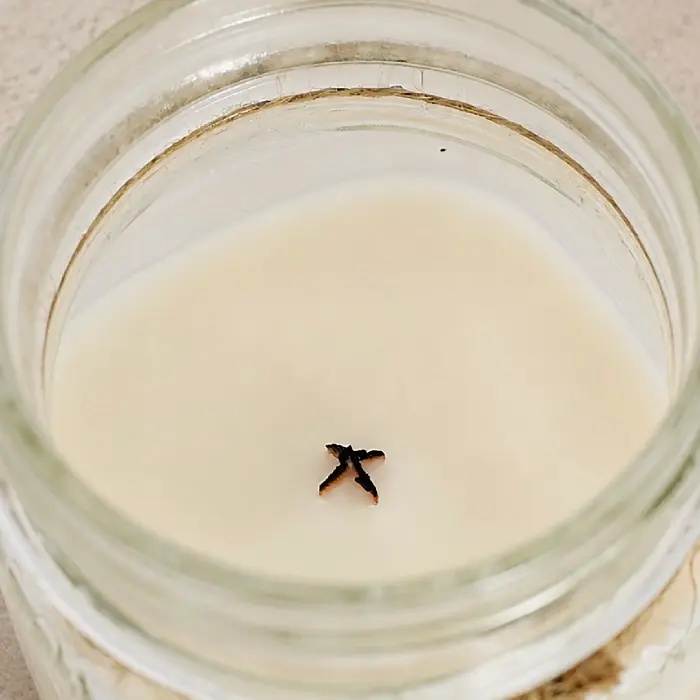
Example of a properly trimmed wooden wick clean-burning soy candle with no soot.
Why candles soot — and why it's the part I'd actually worry about
Everything above is about what goes into a candle. Soot is about what comes out of one, and it's the thing you can measure with your own eyes.
A candle is a system: wick, wax, fragrance and vessel all have to be balanced against each other. When that balance is off, combustion is incomplete — the flame can't fully burn the fuel it's drawing up — and the leftover carbon goes into the air as soot. Three things cause it more than anything else:
-
The wick is the wrong size for the vessel. Too large for the jar diameter and the flame pulls more fuel than it can cleanly burn. You get a tall, flickering flame and a steady stream of carbon
-
The fragrance load is heavier than the wick can carry. This one is underappreciated: fragrance oil is fuel too. Push the load up to make a candle smell stronger on the shelf without re-testing the wick to match, and the wick can't combust it completely. The scent gets stronger, and so does the soot.
-
Nobody burn-tested it. The only way to know whether a specific wick, wax, fragrance and jar work together is to burn the combination all the way down and watch what it does. That's a rigorous process that takes days per formula. It's the step that gets skipped when a candle is built to hit a price; quality is sacrificed to make maximum profit.
Soot is unburned carbon — which is to say it's particulate. Some of it lands on the jar, the wall and the ceiling, which is the part you can see. The rest of it stays airborne in the room you're sitting in.
Even research funded by the candle industry itself concedes the point: when candles were deliberately over-wicked to produce heavy soot, particulate matter rose substantially. The industry's position is that it still stays below air-quality thresholds. Maybe so. I'd still rather not breathe it, and if you've looked at your ceiling I suspect you feel the same way.
From a customer
"I love that I can burn these candles with no harmful black residue. They are clean and crackly!" — Joan B. That's the whole thing in one sentence, and it's a review I'm proud to have earned.
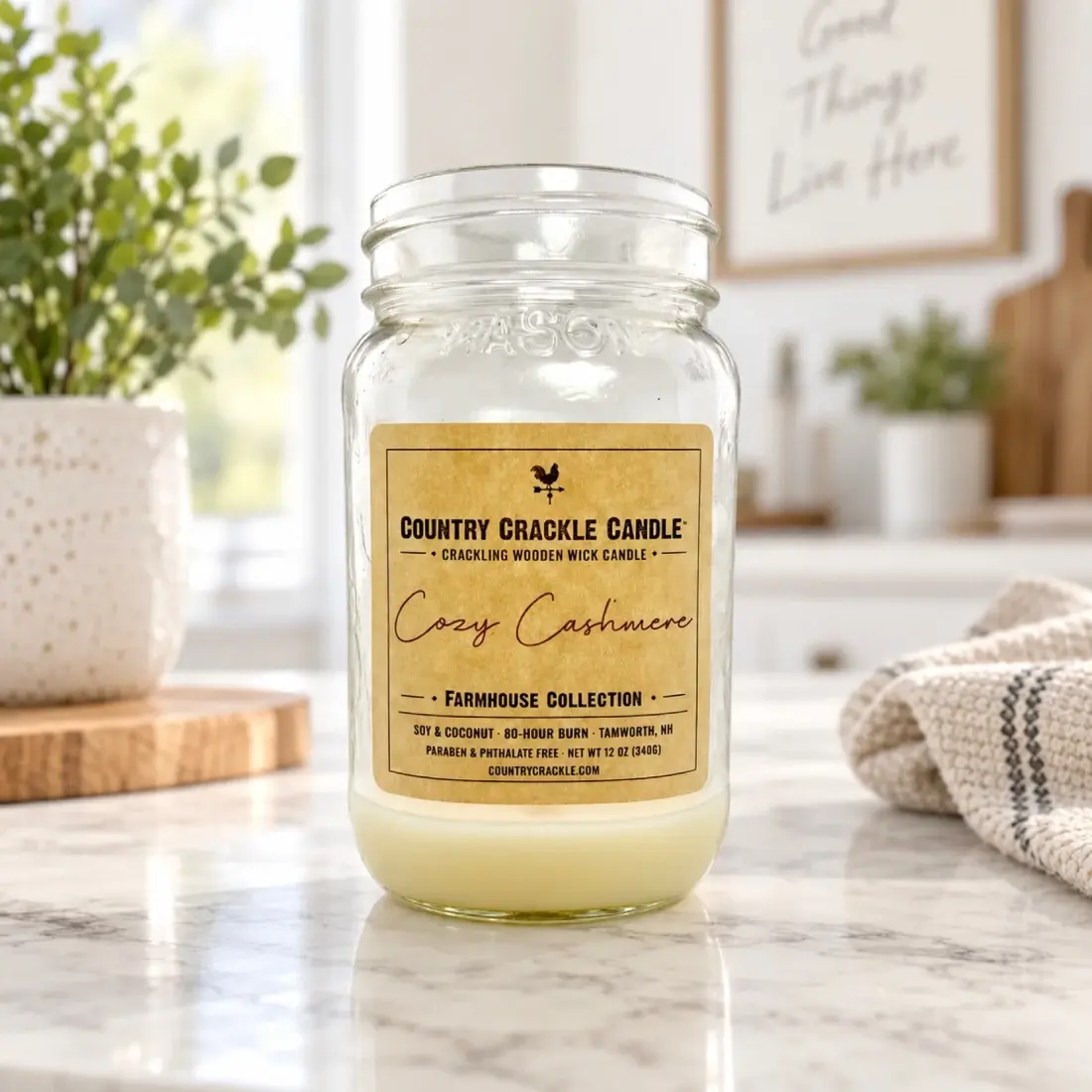
Our candles: clean after burning. No soot. The cleaner alternative.
How our process is a lot different — and why our candles may cost a little more than the big-box brands
I started Country Crackle Candle at my kitchen table because I wanted candles I'd feel good about burning around my own family. That meant I had to know what was in them, which meant making them myself.
Every scent goes through vigorous burn testing before it's allowed to become a product. Not a sample burn — the full jar, all the way down, watching the melt pool, the flame height, the wick behavior and the residue at every stage, over and over again until it's perfect. If a fragrance load makes a candle smell incredible but the wick can't carry it cleanly, the load comes down. That's a sales decision I lose on and a burn decision I win on, and I'll take that trade every time. The longer version of how this started is on our story page.
Here's the spec, stated plainly:
-
Soy coconut wax blend. Not 100% soy, and for good reason — the coconut component burns slower and more evenly and holds fragrance better. The two blend together to give you a superior candle to burn in your home.
-
Phthalate-free fragrance oils. Every scent, every batch, certified by the supplier.
-
No dyes. The color is the wax.
-
A wooden wick. Ours is an X-Wick — two wood wicks crossed — for a fuller flame and the crackle we're named for. Our customers love this wick.
-
Burn-tested in every scent and wick combination until perfect, which is the part that actually determines whether a candle will soot or not.
-
Hand-poured in small batches. Not a production line — which gives us more control over each batch from start to finish. Wax needs to be worked within the right temperature range, and fragrance needs to be added at the proper temperature so it can fully incorporate into the wax and give you a strong, balanced scent both before the candle is lit and while it’s burning. Neither is guaranteed on a line running to a schedule to maximize profits. Hand-poured in small batches means we can pay close attention to those details and maintain consistency from one candle to the next, so you get the best possible quality and value for every dollar you spend on our candles.
If that's the standard you want, the large jar candles are where most people start — 80+ hours, and the Farmhouse Collection is the year-round range. If you'd rather skip an open flame entirely, the soy wax melts and scented room sprays are made to the same spec.
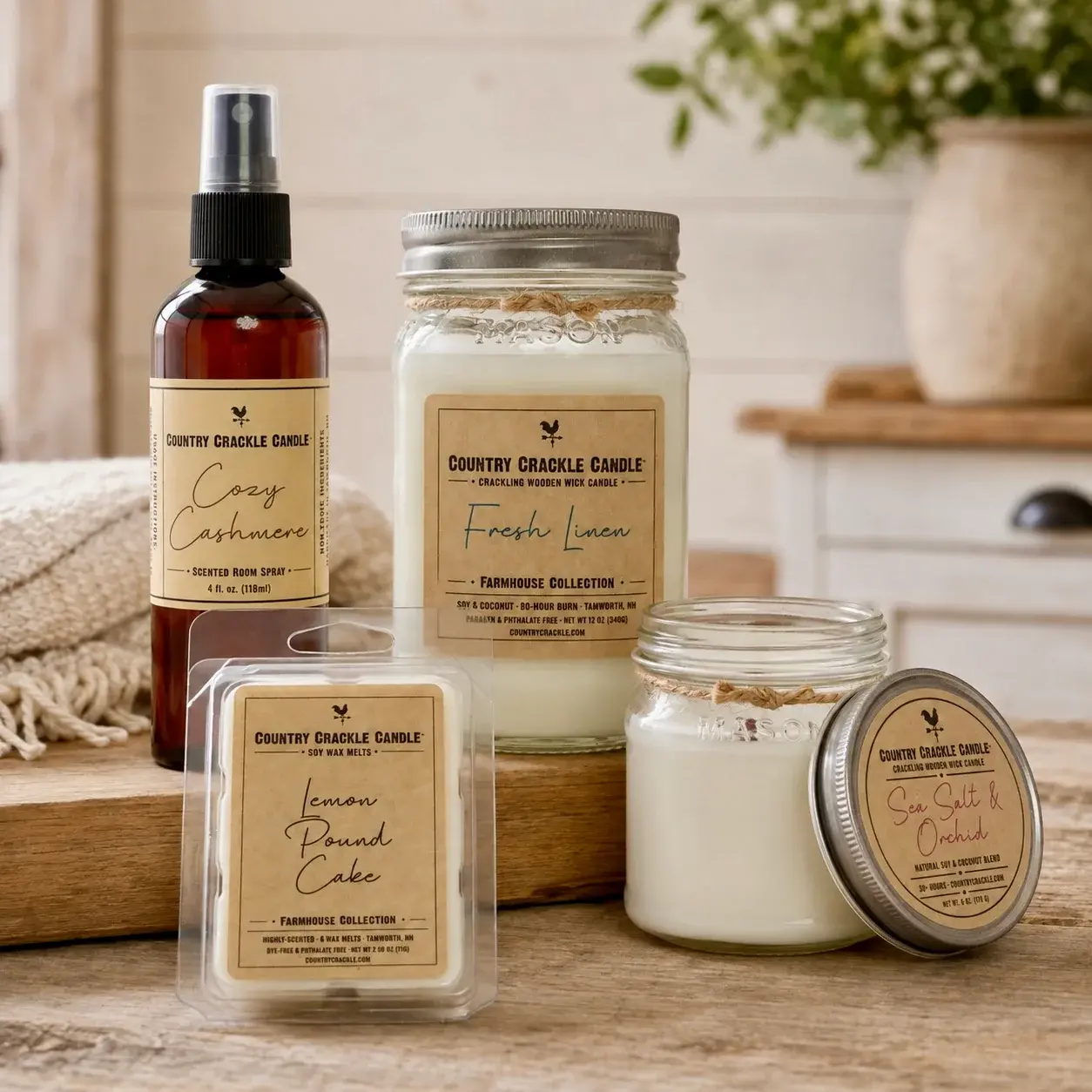
Farmhouse Collection products: Large and small soy candles, soy wax melts, and scented room spray
How to read any candle label — including ours
This works on any candle, from any brand, including ours. Four questions, in order of how much they matter.
-
Does is say phthalate-free? Not "clean fragrance," not "premium fragrance" — the actual word. If it isn't there, you can't assume. This is the single highest-value thing on a candle label.
-
Does it name the wax type specifically? "Soy blend" with no further detail could be mostly paraffin with a touch of soy mixed in. A brand confident in its wax will tell you exactly what's in it.
-
Is it dye-free, and does it say so? Easy to check, easy to avoid, and a reasonable signal of how the rest of the product was thought about.
-
What's the wick made of? Cotton and wood have no metal core. If a brand won't say, that's information too.
And one more that isn't on the label at all: burn one and look at the jar. A candle that soots heavily in a clean, draft-free room is telling you something about how carefully it was created, no matter what the marketing says.
Frequently Asked Questions
-
There's no legal definition applied to candles, which is why the term is used so loosely. In practice, the things worth looking for are phthalate-free fragrance, no synthetic dyes, a wick with no metal core, and a wax you can identify. Beyond the ingredient list, how completely a candle burns matters a great deal — a well-built candle that doesn't soot is putting less particulate into your air than a poorly-built one, regardless of what either label claims.
Know Exactly What You're Burning
Coconut soy wax. Phthalate-free fragrance. No dyes. A wooden wick with no metal core. Burn-tested in every scent and wick combination so it doesn't soot your jar, your walls or your ceiling. 80+ hours, hand-poured in New Hampshire, and backed by our Empty Jar Guarantee — if you don't love it, send it back even empty for a full refund.
Any questions? We're always here. Email us at support@countrycrackle.com and we'll happy to help however we can.
WRITTEN BY
Heather C.
FOUNDER - COUNTRY CRACKLE CANDLE
Mom, candle-maker, and clean-living enthusiast. Every candle from Country Crackle Candle is hand-poured in small batches, from recipes crafted for genuine quality, with one goal: to make you absolutely thrilled with everything you purchase from us.
Live Cozy,
Burn Clean.
INSIDERS CLUB
Join the club & save 10% off
Be the first to hear about new scents, seasonal launches, and subscriber-only sales — straight to your inbox.
Spam-free guarantee. We'll never sell your email or share it with other brands — promise.